YouTube changed how it counts views. Here is what that does to your sponsorship math
Since August 24, 2026, a YouTube view counts from the first frame, so long-form view counts look bigger and every sponsorship CPM worked out on them looks cheaper. Here is what changed, how much it moved by day 30 in our measurement, and how to compare channels, quotes and guarantees on the same basis, with a real run. Updated October 27, 2026 with day-30 data.
On August 24, 2026, YouTube started counting a public view the moment a video starts playing. Before, a long-form view needed real watching before it counted. Nothing about your audience changed that day, but the number on the watch page did.
Update, October 27, 2026. We have now measured day 30, the age sponsorship pricing runs on. For sponsored long-form videos, views at day 30 against the projection the deal was priced on went from 0.93 times (582 videos published June 1 to July 24, 2026) to 1.52 times (402 videos published August 24 to September 26). The same weeks of 2025 went from 0.94 to 0.91, so net of the usual pattern that ratio rose by about 1.7 times. Prices per projected view didn’t move. The numbers in this post are updated below; the first-week figures are still from our September measurement. For what brands pay per projected view by niche and channel size, see YouTube sponsorship cost by niche.
If you buy YouTube sponsorships, that matters more than it sounds. Most of the math in a sponsorship deal runs on views: the cost per thousand views you compare channels on, the projection you price a quote against, and the views guarantee you write into the contract. This post covers what changed, how big the effect was in our measurement, and five rules for comparing like with like, with a real run on a real channel.
What changed on August 24
- A public view now counts from the first frame, with no minimum watch time, for long-form, live, podcasts and Shorts.
- The old number still exists. YouTube Studio calls it engaged views. Only the creator can see it, in Studio’s advanced mode.
- Shorts were already counted this way since March 2025, so for Shorts nothing new happened.
- Old totals were not restated. A video published in June kept its June views. Every view it gets from now on counts the new way, so its lifetime total now mixes both rules.
- The public counters moved late. Studio applied the rule on August 24; in our data, public counts didn’t move until August 28 and 29.
How much it moved, in our measurement
We measured the change three ways: daily view growth on 5,200 channels, view curves at matched ages on 236,594 videos, and side-by-side Studio screenshots from ten creators. The view-growth and view-curve comparisons are measured against the same weeks of 2025, so ordinary seasonal swings are netted out; the creator screenshots are a small check on top, not a controlled comparison. That first measurement ran to September 1, 2026 and covered a video’s first week. On October 27, 2026 we added a day-30 measurement, at the end of this section.
- Long-form went up; Shorts did not. In their first week, new long-form videos showed about 1.2 to 1.5 times the views they would have shown before. That figure compares the new count with the old one; the day-30 numbers below measure something different (delivered views against the projection a deal was priced on), so the two aren’t directly comparable.
- The jump is front-loaded. It is biggest in a video’s first two days and fades by about day 7. That fits browse and autoplay plays, which cluster at launch, now counting as views.
- Smaller channels moved most. Channels with 10K to 100K subscribers went up by about a third on the channel-level counter, against about a tenth for channels over 10M.
- Mid-length videos moved most. Videos of 4 to 20 minutes gained more than very short or very long ones.
- Niche, country and language barely mattered. The effect is about format, length and channel size.
At day 30 (October 27, 2026)
Day-30 views are what sponsorship pricing runs on, so we compared each sponsored long-form video’s views at day 30 with the projection its deal was priced on, for sponsorships booked through ThoughtLeaders.
- Delivered views jumped. Videos published June 1 to July 24, 2026 typically reached 0.93 times their projection (582 videos). Videos published August 24 to September 26 reached 1.52 times (402 videos). The same windows of 2025, with no change, gave 0.94 and 0.91.
- Net of 2025, the ratio rose by about 1.7 times. That is a measured change, not a level: it doesn’t mean every video now delivers that multiple of its projection. Before the change, 42% of sponsored videos reached their projection by day 30; after it, 75% did.
- It isn’t only sponsored videos. Looking at all long-form uploads on 34 channels we sampled, the typical channel’s median day-30 views changed by a factor of 1.47 between the same windows, against 0.89 over the same weeks of 2025.
- Prices didn’t move. Deals bought from August 24 to October 26, 2026 had a median of $23.19 per 1,000 projected views (857 deals), against $23.07 in the two months before (683 deals). For the 180 channels that sold both from February 24 to August 23 and from August 24 to October 26, 2026, the typical channel’s price per projected view changed by a factor of 0.99.
- So the same money buys more public views. Measured on day-30 public views, the median cost per 1,000 for these sponsored videos fell from $29.94 to $17.05. With prices flat and every upload affected, this looks like the counter changing rather than audiences growing, though public counts alone can’t prove it.
These are provisional: the post-change window is about a month of uploads. Treat any single “multiply by X” figure with suspicion, including one from us; the gap varies by channel.
Why a simple average lies, even before the change
Even under one counting rule, the obvious way to size a channel overstates it. Here is TheStraightPipes, a car review channel with 1.81M subscribers, on October 18, 2026: the 12 long-form videos from its last 30 to 90 days that have a day-30 reading (published July 21 to September 14, 2026; a September 18 upload had not been read at day 30 yet), from ThoughtLeaders data.
| How you average the 12 videos | Views | Against the projection |
|---|---|---|
| Simple average of today’s public views | 232,445 | 49% higher |
| Simple average of each video’s views at day 30 | 215,912 | 38% higher |
| Median of the day-30 views | 133,046 | 15% lower |
| Day-30 views, outliers capped | 157,021 | under 1% higher |
| ThoughtLeaders projected views (long-form) | 156,482 |
Three videos move the average most: a personal video about a car the host bought reached 557,877 views by day 30, and two new-model reviews passed 450,000, each more than three times the channel’s median. Average them in at full size and the channel looks like it hits that level every time. Reading each video at day 30 removes the advantage older videos have from simply being up longer. Capping anything above twice the median (and dropping anything under a quarter of it) keeps the hits in the number without letting them set it. That is how ThoughtLeaders projects views, separately for long-form, Shorts and live. The platform recomputes its number on its own schedule, so our hand calculation on the same day lands close to it rather than exactly on it.
Now add the view-count change. Of these 12 videos, 6 were published after August 24 and counted entirely on the new rule. Another 5 were published before it but reached day 30 after it, so their day-30 views mix both rules. Only one reached day 30 before the change. This channel’s projection is already mostly on the new basis, and because it is built from videos 30 to 90 days old, it will be fully on the new basis by late November. A projection you saved in early August and one you pull today are measured with different rulers.
What it does to your sponsorship math
- CPMs on public views look cheaper. Divide a quote by today’s public views and the cost per thousand views drops, even though the audience is the same. In our sponsored long-form videos, prices per projected view held flat while the median cost per 1,000 day-30 public views fell from $29.94 to $17.05. That fits the counter changing rather than the audience getting cheaper, though public counts alone can’t prove it.
- Quotes priced before August 24 sit on the old basis. A deal priced on a projection built before the change is an old-basis price. Comparing its CPM with a new quote on public views mixes two rulers.
- Projections are drifting. A day-30 projection is built from videos 30 to 90 days old. As videos published after August 24 age into that window, projections move up for counting reasons alone, and by late November most will be fully on the new count. Until then a projection usually mixes both rules, which is part of why sponsored videos are now beating theirs so often.
- Older metrics are mixed. Anything that spans the change, like a video that reached day 30 in September or a lifetime total, contains views counted both ways.
Five rules for buying after the change
- Compare day-30 views to day-30 views, counted the same way. Not lifetime totals, not a simple average, and not an old-basis number against a new one. A day-30 reading for a long-form video published after August 24 is on a different ruler from one published in July.
- Ask the creator for engaged views. A Studio screenshot of views and engaged views on their recent long-form videos tells you exactly how far the public number runs ahead of the old one on that channel.
- Write guarantees in engaged views at a fixed age. For example: an agreed number of engaged views by day 30, from the creator’s Studio. A guarantee on public views set from old-basis history is now much easier to hit: 75% of recent sponsored long-form videos beat their projection by day 30, against 42% before the change. If you must use public views, raise the number to match.
- Price Shorts separately. Shorts didn’t change, so their numbers need no adjustment. Never blend Shorts and long-form in one average.
- Discount “my views jumped” stories. In our data, 37% of channels were up more than 30% week on week after the change, but 17% were up that much in the same weeks of 2025, with no change at all. Much of any single channel’s jump is ordinary variation, and since August the counter itself lifts every long-form upload. Ask how a channel’s day-30 views moved against similar channels, not against its own July.
Ask your agent to check a channel
You don’t need to rebuild that table by hand. With the ThoughtLeaders CLI connected, ask:
Show me TheStraightPipes’ projected views by format, and tell me how many of the videos behind the long-form number reached day 30 after August 24, 2026.
Your agent starts with:
tl channels show "TheStraightPipes"then pulls each recent long-form video’s views at day 30. On October 18, 2026 that returned projected views of 156,482 for long-form and 43,072 for Shorts, no live projection (the channel doesn’t stream enough), and 11 of the 12 day-30 readings taken after August 24.
Two follow-ups worth asking in the same conversation:
- “Compare this channel’s cost per thousand views on a quote we got in July with one we got this week, and tell me which basis each is on.”
- “Before we write a views guarantee, what engaged-views number should we ask the creator to confirm from YouTube Studio?” The views guarantee skill sizes a guarantee from the channel’s recent day-30 views; keep public and engaged counts separate when you set it.
See it on the channel
Open any channel on YouTube with the ThoughtLeaders Chrome extension installed. Under each video you see its projected views next to its views over time, and the performance panel shows twelve months of history with a 30-day projection. You can see right away whether a video’s public count is running far ahead of what the channel usually reaches at day 30.
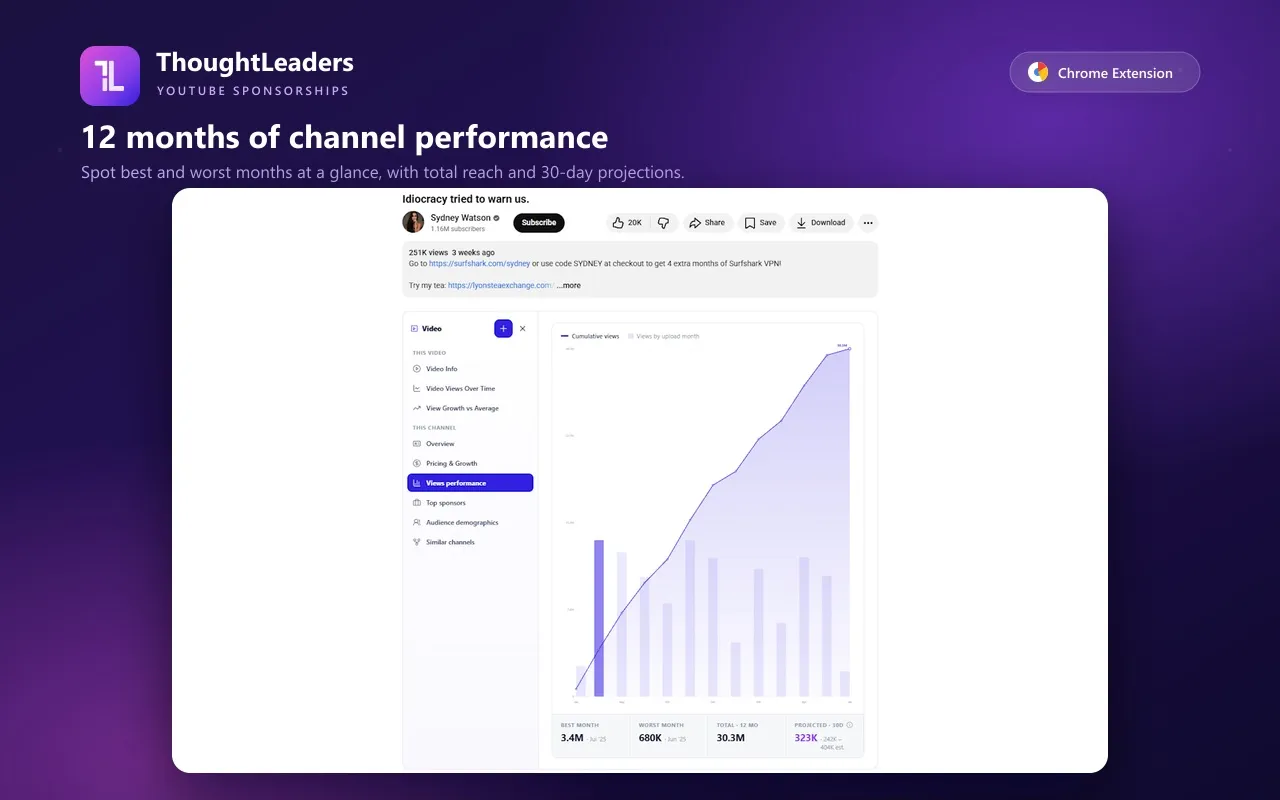
The screenshot shows the extension on a different channel, to illustrate the panel.
What we still don’t know
- Whether prices rebase as projections catch up. Prices per channel have held so far. As more post-change videos feed the projections, roughly by late November, we’ll check whether prices rise with them or the price per projected view drops.
- Anything past day 30. Our post-change videos were published by September 26, so we have day-30 readings only. We’ll re-measure longer windows as they age and add a dated note here.
- Engaged views at scale. The old count now lives only in each creator’s YouTube Studio. We measure public counts, so we can’t show directly how much of the jump is the counter and how much is real audience; the creator screenshots we have are a small sample.
- The effect by niche. In the first week, niche barely mattered. We don’t yet have enough post-change sponsored videos to measure the day-30 effect niche by niche.
- A broader control. The all-uploads check covers 34 sampled channels that have sold through ThoughtLeaders, not a random sample of YouTube.
Try it on a channel you are about to book
Install the CLI and ask your agent for the channel’s projected views and what they are built on, or add the Chrome extension and open the channel on YouTube. If you already have a quote, the quote check walks through turning the gap into a counter-offer.